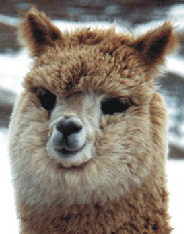
Alpacas
are a domesticated member of the camel (camelid) family. The
camelid family also includes llamas, guanacos, and vicunas from South
America, and the Bactrian and Dromedary camels from Asia and Africa.
This family of animals originated on the plains of North America about
10 million years ago.
A common ancestor to the South American
camelids migrated to South America about 2.5 million years ago.
Two wild species, vicunas and guanacos, emerged. They still live
in the Andes. It is believed that about 6,000 years ago alpacas
were created through selective breeding which was heavily influenced by
the vicuna. There are similarities in size, fiber, and dentition
(teeth) between the alpaca and the wild vicuna.
|
|
| Today there are about 3.5
million alpacas in the Andean highlands, most of which can be found in Peru.
Since the major first importation into the U.S. in 1984, the North American herd
has increased from a few alpacas in zoos and private collections to about
20,000. Alpacas are popular internationally for their luxury fiber and as
pet, show, and investment animals in Canada, England, Australia, New Zealand,
Poland, France, and Israel, as well as the United States. |
|
Reproduction,
Birth & Babies:
Male alpacas reach sexual maturity at about 2 1/2 years of age.
females are first bred at 16 - 20 months of age. Like other South
American camelids, alpacas do not have a heat (estrus) cycle and can be bred
any time of the year. An average gestation of 335 days produces
a single baby (cria) which is usually delivered from a standing position
during daylight hours. Twinning is extremely rare and rarely
compatible with life.
Breeds,
Fiber, & Color:
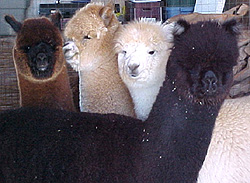
The two coat or breed types are the huacaya and the suri. Both fleeces are soft and free of guard hair. Ninety
percent of alpacas are huacaya, with full, puffy fleeces whose crimp or
curvature is in the individual fibers. The lustrous, straight fiber of the
suri fleece hangs down, giving the suri alpaca an entirely different
appearance. Fibers of both types are considered luxury fibers in the
textile trade because of their unique qualities. Tuis or yearling
alpacas provide the finest fleeces. Depending upon its weight,
quality, and cleanliness an alpaca fleece commands $200 - $400. The
eight basic colors are white, fawn, caramel (light brown), black, gray,
brown (coffee), red, and piebald (colored blanket on a white body).
FREQUENTLY
ASKED QUESTIONS
What
are alpacas used for?
Alpacas are shorn for their valuable fleeces. Its compact size
contributes to easy management and to a desirability as a companion animal.
Alpacas easily learn to lead, jump in and out of vehicles, kush (sit down),
and obey other simple commands taught all domestic members of the camelid
family. They are popular show animals. Alpacas can also be seen
at fairs and fiber fests throughout North America. No other animal
which produces fiber for textile use has such an enormous variety of colors
as alpacas. As in ancient days, alpacas are a mainstay to the
Andean livestock economy, providing luxury fiber for export to the world
marketplaces and meat for the Andean people.
What
do they eat?
Alpacas are modified ruminants. They rank high in digestive
efficiency and do well on good quality, low protein forage and hays.
Occasional supplemental feeds, vitamins, and minerals are provided when
required. An alpaca costs far less to feed than most traditional
domestic animals.
What
is their personality like?
Alpacas are alert, curious, calm and predictable. They need the
companionship of other camelids, and will huddle together or move en masse
when frightened or wary.
How
do they communicate?
Alpacas express themselves with a soft hum, with other vocalizations,
and with body language, such as neck posturing, ear and tail positioning,
and head tilt. They have excellent eyesight and hearing, and will alert the
herd and their human keepers with a staccato alarm call of perceived danger.
Alpacas rarely spit at people unless frightened or abused, but will use this
form of communication with each other to register a complaint.
|